Our approach to services at聽CEPS聽is based in the behavioral ecological consultation model (Sheridan & Kratochwill, 2007), which is an聽indirect service delivery model聽that focuses on supporting and training individuals (parents, teachers, other helping professionals) within the student鈥檚 daily context (home, school). This is in contrast with direct service delivery models where professionals provide the intervention directly to the student. The indirect model is used at CEPS as it allows for greater generalization and sustainability of change by addressing the problems a student may face in their natural environment and by building competencies of individuals and organizations in the student鈥檚 life to better support their needs.
Behavioral Perspective
The theoretical foundation of CEPS is grounded in the Behavioral Perspective that includes聽Applied Behavior Analysis听(础叠础),听Positive Behavioral Interventions and Supports聽(PBIS) and聽Contextual Behavioral Science聽(CBS). This behavioral perspective emphasizes the 鈥渁ct in context鈥�, working with students and schools within the immediate and broader context in which they are situated to better address needs, enhancing existing strengths and working in a problem-solving process for continuous improvement.
Analysis of the context in which the child is situated includes looking at the聽antecedents, the聽behavior聽of interest and the聽consequences聽of the behavior to develop support plans. This contextual behavioral analysis is further expanded by taking into account learning/developmental histories of the child, current skill levels and evaluating the child鈥檚 environment to see how it can be enhanced to better meet the child鈥檚 need. For school systems, similar contextual analysis is done to determine what context can be cultivated to best meet the school or classroom鈥檚 needs, what was the history of the system and what skills are present in the system currently.
Ecological Systems Theory
In addition to the behavioral perspective, CEPS also incorporates the ecological systems perspective (Bronfenbrenner) to include the focus on systems (family, school, communities) and how they interact to influence the students or the organizations. These multiple overlapping ecological systems are further broken down into multiple levels and include:
- Within Individual System聽– biological and psychological context of the individual (i.e., genetics, medical conditions, etc.)
- 惭颈肠谤辞蝉测蝉迟别尘听– immediate system the child is in (family, schools)
- 惭别蝉辞蝉测蝉迟别尘听– interactions among microsystems (home-school interactions)
- 贰虫辞蝉测蝉迟别尘听– systems that the child may not directly interact with but has impacts on microsystems (i.e., parental work stress, school policy)
- 惭补肠谤辞蝉测蝉迟别尘听– include cultural practices and influences
- Chronosystem – looks at system and development across time

Evidence-Based Practices

As the title of CEPS indicates, we are committed to providing聽evidence-based practices聽in schools. Evidence-based practices include three interconnected principles that include聽Best Research Evidence, Clinical Expertise聽and聽Client Values.聽
Best research evidence聽is based on scientific evidence at two different levels. At the first level, the practice should be based on evidence that聽it works聽from well-controlled experimental studies that demonstrate efficacy and effectiveness. Additionally, the second level of research involves studies that look at the underlying theory or聽why the practice works.
Clinical Expertise聽involves the decision making process and opinions of highly trained individuals that have clinical expertise.
Client Values聽focuses on goals and values of the clients to provide high quality that reflect those values.
Specifically, at CEPS these principles of evidence-based practices incorporate collaboratively working with consultees to develop聽measurable goals聽and聽valued outcomes,聽individualized assessments, providing聽explicit training聽and聽support聽for intervention implementation,聽data-based decision making, and providing on-going聽monitoring聽and聽modification.
Tiered Public Health Model of Services
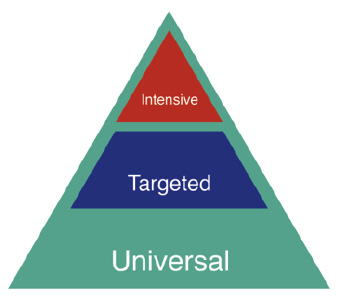
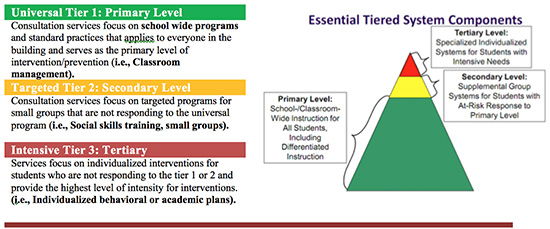
One increasingly supported evidence-based practice in schools is the tiered public health model of service delivery, that organizes evidence-based practices across multiple overlapping levels. Typically, these include聽耻苍颈惫别谤蝉补濒听practices that apply to everyone,聽迟补谤驳别迟别诲听practices that are added to groups that need it and听颈苍迟别苍蝉颈惫别聽practices for those that are not able to improve from the other two tiers. This model emphasizes the systems approach by looking at all the practices in schools and providing schools with a decision making procedure for how to use their resources and organize services.
Multi-tiered Systems of Support & Interconnected Systems Framework
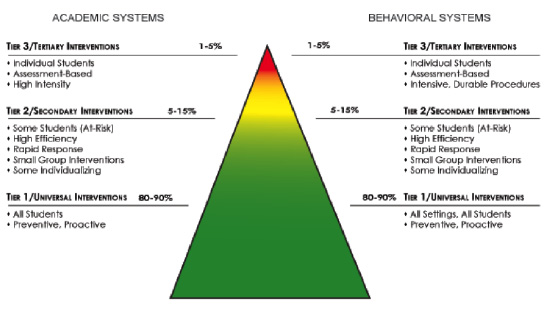
CEPS is grounded in the framework of聽Multi-Tiered Systems of Support (MTSS)聽(increasingly intensive tiers of interventions) and聽Interconnected Systems Framework (ISF)聽(linking school, families, communities and other support systems). MTSS is an evidence-based framework for approaching sustainable change in school, which allows for school-wide, class-wide and individualized interventions, based on the level of needs (typically start at school-wide level and progress to more specific interventions if the student does not respond to the broader programs). The ISF initiatives build on MTSS by coordinating across different organizations to better meet the needs of children (i.e., collaboration between teacher and parents or between hospital and school professionals).
MTSS also ranges from academic to behavioral (mental health/social-emotional) concerns, which is typically conceptualized as shown in the diagram below. Academic MTSS is often called聽Response to Intervention(RTI) even though the term can also be used for behavior. Behavioral MTSS programs include聽Positive Behavioral Interventions and Supports听(笔叠滨厂),听School Mental Health聽(SMH), and聽Social Emotional Learning听(厂贰尝).